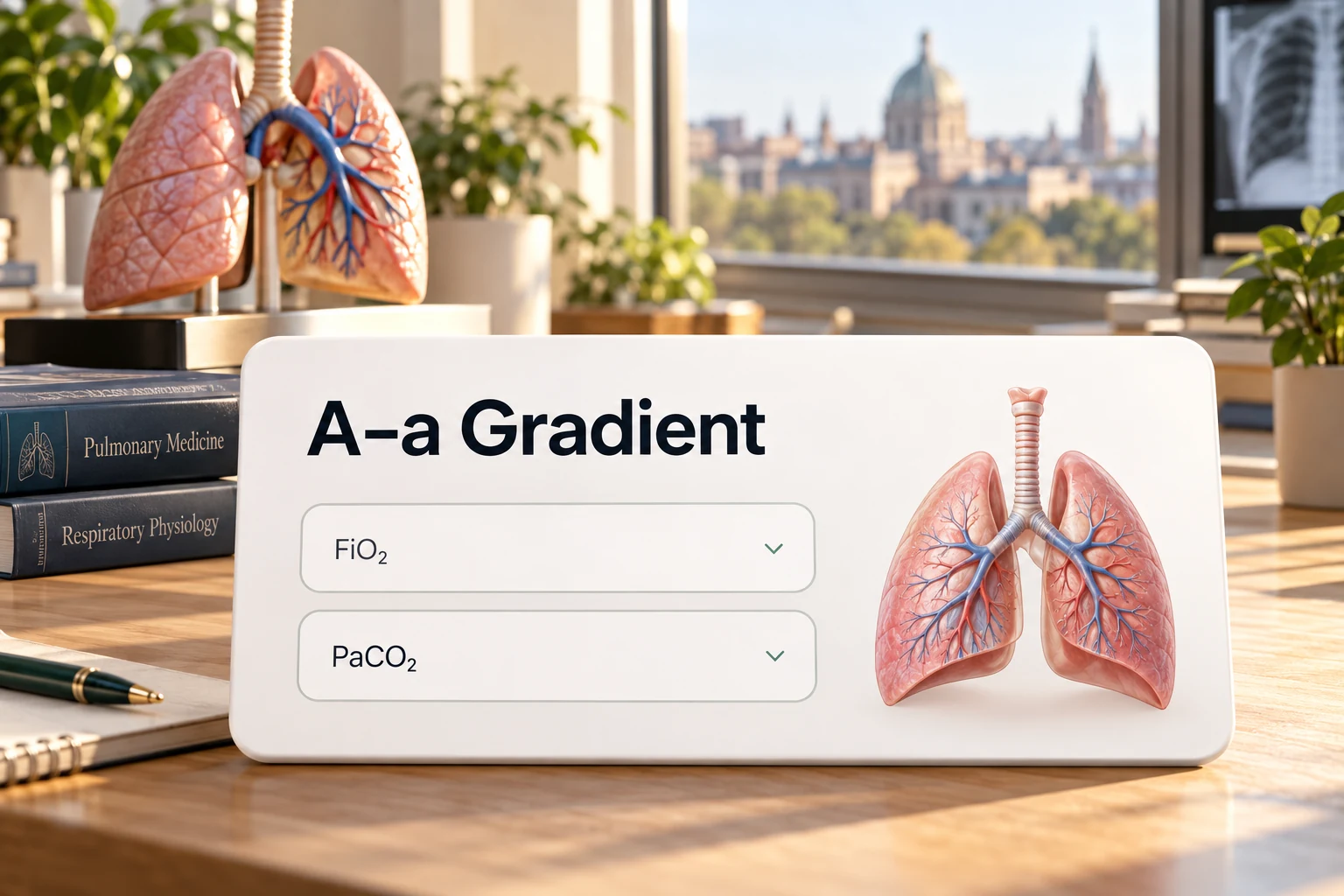
A-a Oxygen Gradient calculator
Result
9.7mmHg
Normal A-a gradient
Expected for age 40: ~11 mmHg.
How to use it
- 1
Record FiO₂. 21% on room air; calculate or estimate on supplemental O₂.
- 2
From ABG: PaCO₂ and PaO₂. Ensure sample is arterial.
- 3
Interpret. Normal A-a with hypoxia → hypoventilation. Elevated A-a → V/Q mismatch, shunt, or diffusion limitation.
When to use it
- Hypoxia workup
- Differentiates hypoventilation (normal A-a, e.g., opioid) from parenchymal (elevated A-a, e.g., PE/pneumonia).
- PE assessment
- PE classically gives elevated A-a with low PaCO₂ (hyperventilation).
- ARDS
- PaO₂/FiO₂ <300 + elevated A-a in bilateral infiltrates = Berlin criteria.
A reference for clinicians and students, not medical advice. A score supports a decision; it does not make one. Check every result against the patient in front of you and your local protocol.
At a glance
- Specialty
- Pulmonology
- Inputs
- 4
- Type
- Formula
More in pulmonology
- Wells' Criteria (PE)Pulmonology · 7 inputs
- Revised Geneva Score (PE)Pulmonology · 8 inputs
- PERC RulePulmonology · 8 inputs
- CURB-65Pulmonology · 5 inputs
- PSI / PORT ScorePulmonology · 20 inputs
- PaO₂/FiO₂ RatioPulmonology · 2 inputs
- BODE IndexPulmonology · 4 inputs
- mMRC Dyspnoea ScalePulmonology · 1 input
- GOLD COPD StagingPulmonology · 2 inputs
- DECAF ScorePulmonology · 5 inputs
- Berlin ARDS CriteriaPulmonology · 6 inputs
- FEV₁ % PredictedPulmonology · 4 inputs