Critical care
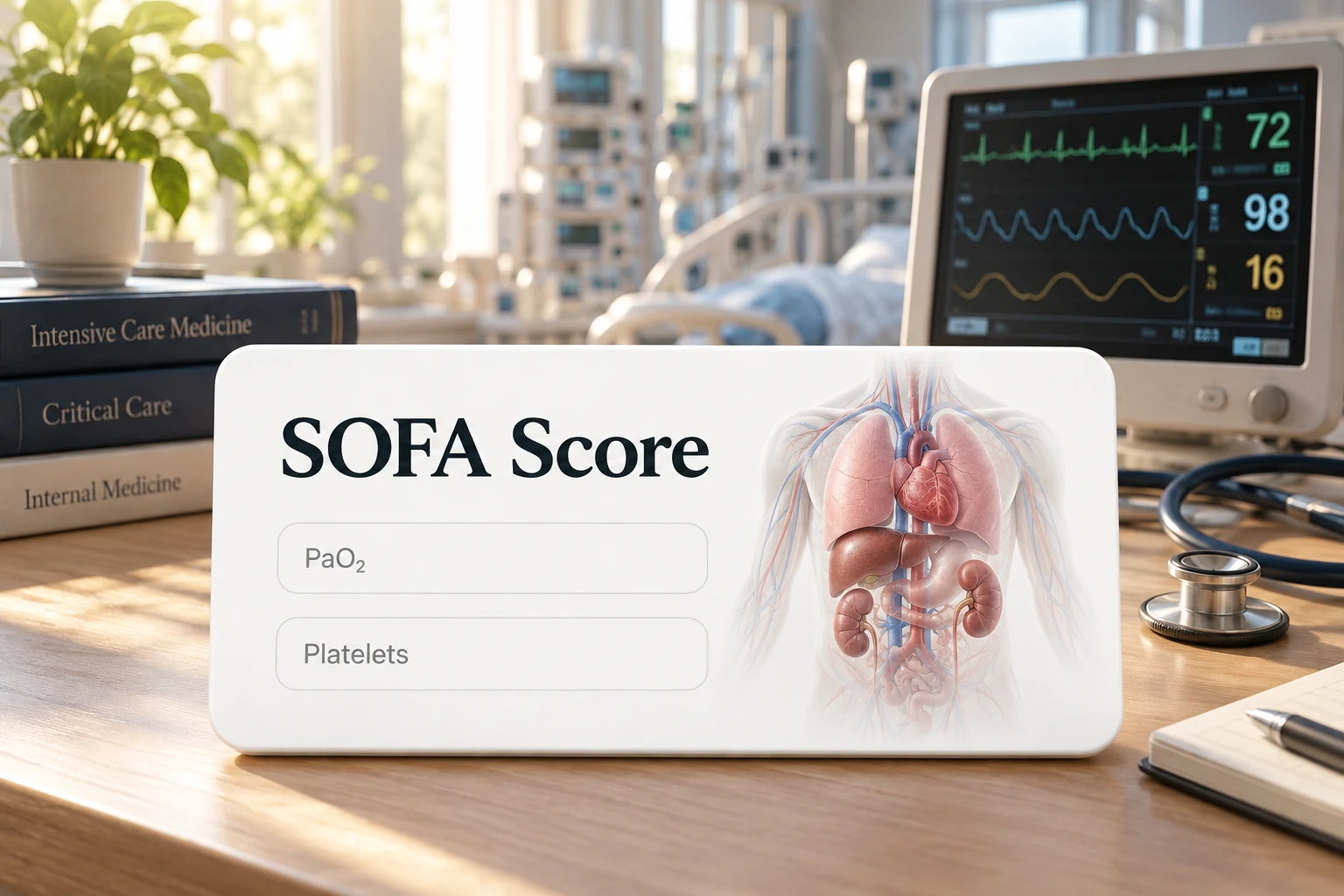
Sequential Organ Failure Assessment Score
Calculate organ dysfunction severity in ICU patients.
SOFA Score calculator
Result
0/24
ICU mortality ~10%
How to use it
- 1
Six organ systems. Respiratory (PF ratio), coagulation (platelets), neurological (GCS), hepatic (bilirubin), cardiovascular (MAP/vasopressors), renal (creatinine/UO).
- 2
Delta SOFA. Change in SOFA over time predicts outcome better than single value.
- 3
Sepsis-3 definition. Sepsis = suspected infection + acute SOFA increase ≥2 from baseline.
When to use it
Use in all ICU patients for daily monitoring of organ dysfunction, prognosis estimation, and to operationalise the Sepsis-3 definition of sepsis in patients with suspected infection.
- ICU admission and daily monitoring
- Serial SOFA tracks organ dysfunction trajectory.
- Sepsis diagnosis
- SOFA ≥2 from baseline = sepsis. Lactate ≥2 + SOFA ≥2 = septic shock (independently).
- Resource allocation
- In pandemics, SOFA helps triage scarce ICU resources consistently.
About the score
The Sequential Organ Failure Assessment (SOFA) score is the gold-standard tool for quantifying organ dysfunction in critically ill patients. It evaluates six organ systems — respiratory, coagulation, hepatic, cardiovascular, neurological, and renal — each scored 0 to 4, giving a total of 0 to 24. According to the Sepsis-3 consensus definitions (2016), sepsis is defined as a life-threatening organ dysfunction caused by a dysregulated host response to infection, operationally identified by an acute increase in SOFA score of ≥2 points from baseline in a patient with suspected infection. SOFA is also used as a prognostic tool, with higher scores correlating with increased ICU mortality.
Sequential Organ Failure Assessment
Scoring criteria
- Respiratory: PaO₂/FiO₂ ratio (mmHg)≥400=0, 300–399=1, 200–299=2, 100–199 with ventilation=3, <100 with ventilation=4
- 0–4
- Coagulation: Platelets (×10³/µL)≥150=0, 100–149=1, 50–99=2, 20–49=3, <20=4
- 0–4
- Liver: Bilirubin (µmol/L)<20=0, 20–32=1, 33–101=2, 102–204=3, >204=4
- 0–4
- Cardiovascular: Mean arterial pressure / vasopressorsMAP ≥70 mmHg=0, MAP <70=1, dopamine ≤5 or any dobutamine=2, dopamine >5 or adrenaline/noradrenaline ≤0.1=3, dopamine >15 or adrenaline/noradrenaline >0.1=4 (doses in µg/kg/min, given for at least 1 hour)
- 0–4
- Neurological: Glasgow Coma ScaleGCS 15=0, 13–14=1, 10–12=2, 6–9=3, <6=4
- 0–4
- Renal: Creatinine (µmol/L) or urine output<110=0, 110–170=1, 171–299=2, 300–440 or UO<500ml/d=3, >440 or UO<200ml/d=4
- 0–4
Score interpretation
- 0–6Low dysfunctionICU mortality <10%; monitor closely
- 7–9Moderate dysfunctionICU mortality ~15–20%; review organ support
- 10–12High dysfunctionICU mortality ~40–50%; optimise organ support
- ≥ 13Severe dysfunctionICU mortality >50–80%; consider goals of care
Guideline recommendation
Sepsis-3 Consensus (JAMA 2016): sepsis is life-threatening organ dysfunction caused by a dysregulated host response to infection, identified clinically as suspected infection + acute SOFA increase ≥2 from baseline. Septic shock = sepsis + vasopressors needed to maintain MAP ≥65 mmHg + lactate >2 mmol/L despite adequate fluid resuscitation. SOFA replaces SIRS criteria for sepsis diagnosis.
Clinical pearls
- An acute SOFA increase of ≥2 from baseline defines sepsis per Sepsis-3 — baseline is assumed to be 0 in patients without known prior organ dysfunction.
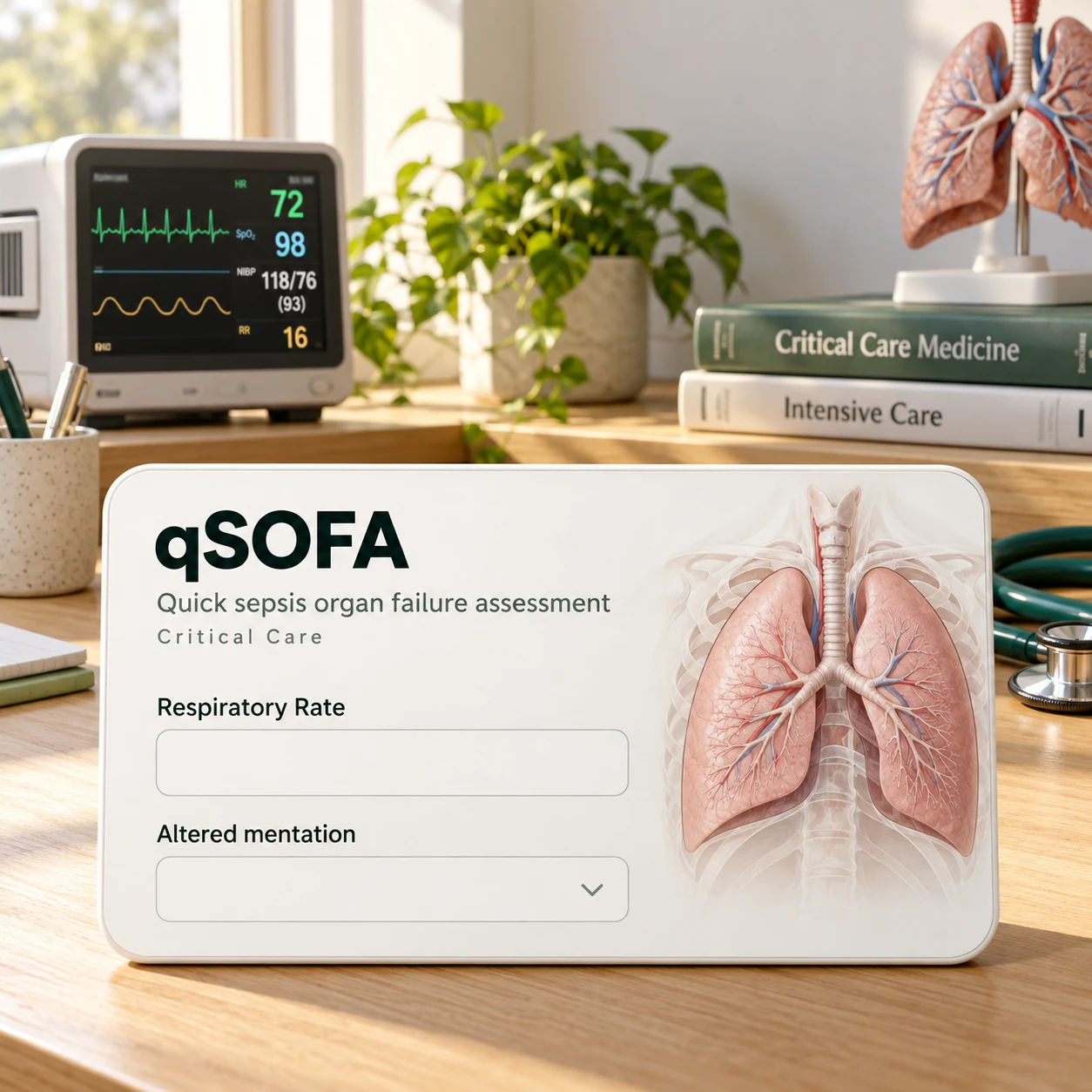
- qSOFA (respiratory rate ≥22, altered mentation, SBP ≤100) is the bedside screening tool; SOFA is the confirmatory diagnostic tool.
- Serial SOFA scores are more predictive than a single value — a rising score predicts worse outcomes regardless of absolute level.
- The cardiovascular component requires knowledge of exact vasopressor dose; record it weight-based, in µg/kg/min.
Limitations
- Requires ICU-level data (PaO₂ measurement, vasopressor doses) — not fully applicable to general ward patients.
- Baseline SOFA is often assumed to be zero, which overestimates the acute change in patients with pre-existing organ dysfunction.
- Not designed as a direct treatment decision tool — it quantifies dysfunction, not causality.
A reference for clinicians and students, not medical advice. A score supports a decision; it does not make one. Check every result against the patient in front of you and your local protocol.
At a glance
- Specialty
- Critical care
- Inputs
- 6
- Type
- Points score
- Guidelines from
- SCCM, ESICM
Frequently asked questions
What SOFA score defines sepsis?
Per the Sepsis-3 consensus (2016), sepsis is life-threatening organ dysfunction caused by a dysregulated host response to infection. Clinically, it is identified by an acute increase in SOFA score of ≥2 points from baseline in a patient with suspected or confirmed infection; the SOFA score operationalises the organ dysfunction.
What is the difference between SOFA and qSOFA?
SOFA is the full six-organ scoring system requiring lab values and ICU parameters. qSOFA (quick SOFA) is a rapid bedside screen using three criteria: respiratory rate ≥22/min, altered mentation (GCS <15), and systolic BP ≤100 mmHg. qSOFA identifies patients outside the ICU who may be deteriorating; a positive qSOFA (≥2) warrants full SOFA assessment.
What is a normal SOFA score?
A SOFA score of 0 represents no organ dysfunction across all six systems. Each organ system scores 0 (normal) to 4: 1–2 points reflect mild to moderate dysfunction, 3–4 points severe dysfunction (organ failure). For prognosis in ICU patients, a total score ≥11 is associated with >40% ICU mortality in most published cohorts.