Critical care
Quick Sequential Organ Failure Assessment
Rapidly screen for sepsis at the bedside using three clinical criteria.
qSOFA calculator
Result
0/3
qSOFA < 2 — low risk outside ICU
How to use it
- 1
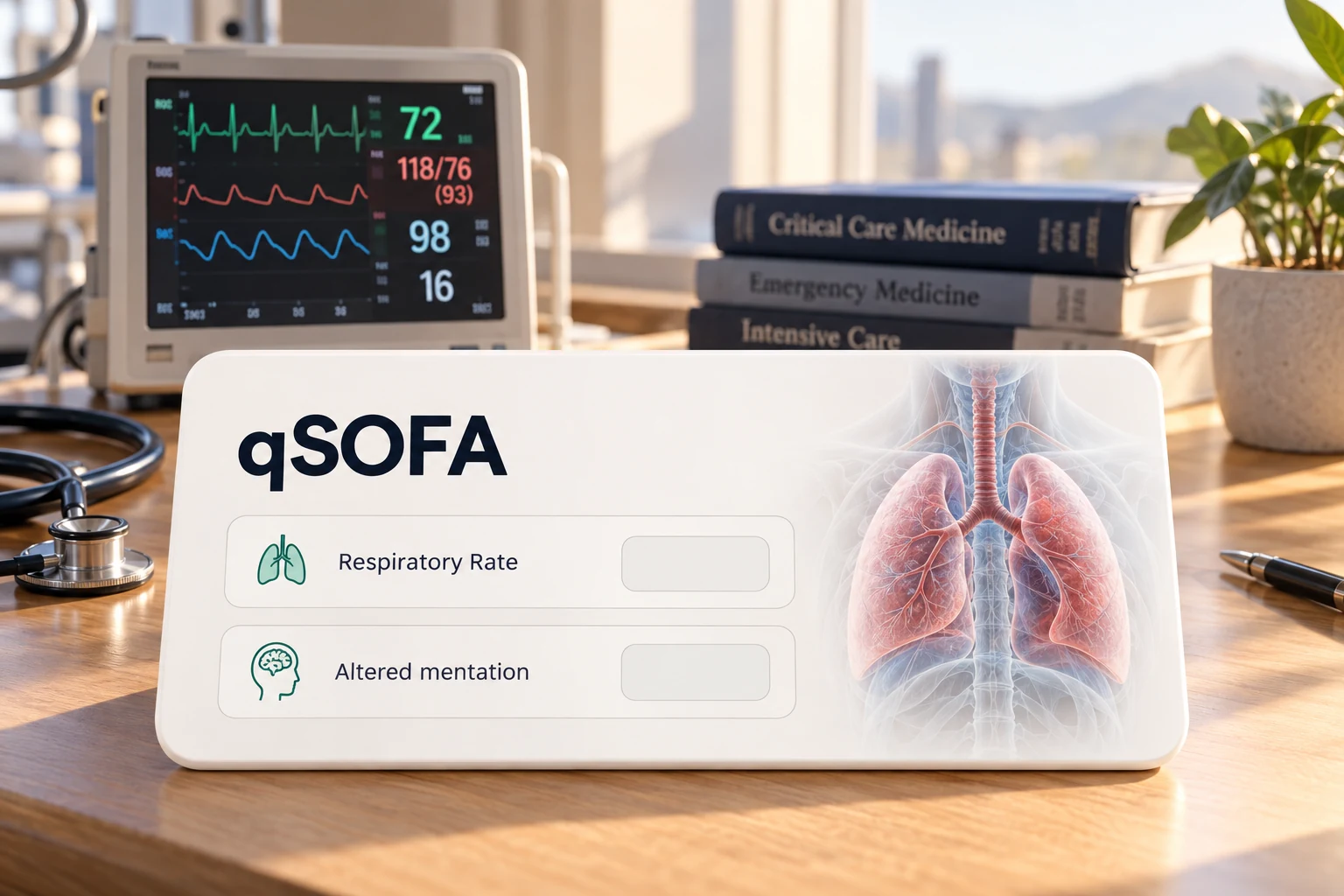
3 bedside criteria. RR ≥22, altered mentation (any GCS <15), SBP ≤100.
- 2
Threshold ≥2. Identify patients likely to have poor outcome due to infection outside ICU.
- 3
qSOFA is not a sepsis definition. Sepsis-3: suspected infection + SOFA ≥2. qSOFA is a screening prompt, not diagnostic.
When to use it
Use as a bedside prompt in patients with suspected infection outside the ICU, particularly in emergency departments and general wards, together with a broader screen such as NEWS2 rather than on its own. Positive qSOFA should trigger full SOFA assessment, blood cultures, lactate measurement, and urgent clinical review.
- Ward and ED rapid screen
- qSOFA ≥2 in patient with suspected infection: urgent SOFA, lactate, blood cultures.
- Not for ICU
- SOFA is the validated tool in the ICU setting.
- Outpatient/community
- qSOFA performed well in non-ICU settings across Sepsis-3 validation cohorts.
About the score
The quick SOFA (qSOFA) score is a rapid, three-criterion bedside tool introduced with the Sepsis-3 consensus definitions in 2016. It was designed to identify patients outside the ICU — in emergency departments, general wards, or primary care settings — who may have sepsis and are at risk of poor outcomes. Unlike the full SOFA score, qSOFA requires no laboratory tests, making it immediately applicable in any clinical setting. A positive qSOFA (≥2 of 3 criteria) should prompt clinical reassessment, consideration of sepsis, and escalation of care — including measurement of lactate and blood cultures.
Quick Sequential Organ Failure Assessment
Scoring criteria
- Respiratory rate ≥ 22 breaths/min
- 1
- Altered mentation (GCS < 15)
- 1
- Systolic blood pressure ≤ 100 mmHg
- 1
Score interpretation
- 0–1qSOFA negativeSepsis less likely — continue assessment if clinically concerned
- ≥ 2qSOFA positiveSuspect sepsis — escalate care, measure lactate, blood cultures, full SOFA
Guideline recommendation
Sepsis-3 (JAMA 2016): qSOFA ≥2 outside the ICU should prompt clinicians to investigate for organ dysfunction. It does not replace full SOFA for the sepsis diagnosis but serves as a rapid bedside prompt for clinical concern. Surviving Sepsis Campaign 2021: using qSOFA as a single screening tool for sepsis or septic shock is not recommended, compared with SIRS, NEWS or MEWS (strong recommendation, moderate-quality evidence), because it misses too many cases.
Clinical pearls
- qSOFA is a screen, not a diagnostic test — a score of 0–1 does not exclude sepsis if clinical suspicion is high.
- Many guidelines now use NEWS2 (National Early Warning Score 2) alongside qSOFA on general wards — both are complementary.
- If qSOFA ≥2, act immediately: blood cultures, IV access and lactate. When sepsis is probable or shock is present, give broad-spectrum antibiotics within 1 hour of recognition; when sepsis is possible without shock, investigate rapidly and give antibiotics within 3 hours if the concern persists (Surviving Sepsis Campaign 2021).
- Altered mentation is a powerful predictor — any acute change in GCS, confusion, or agitation in an infected patient should raise concern.
Limitations
- Lower sensitivity than SIRS criteria for identifying sepsis — will miss some cases.
- Not validated in immunocompromised patients, where the inflammatory response may be blunted.
- Should not replace clinical judgement in patients with known chronic disease affecting the criteria (e.g., COPD with chronic tachypnoea).
A reference for clinicians and students, not medical advice. A score supports a decision; it does not make one. Check every result against the patient in front of you and your local protocol.
At a glance
- Specialty
- Critical care
- Inputs
- 3
- Type
- Points score
- Guidelines from
- SCCM, ESICM
Frequently asked questions
What is a positive qSOFA score?
A qSOFA score of ≥2 out of 3 is considered positive and indicates that sepsis should be suspected. This should prompt immediate escalation: blood cultures, lactate measurement, IV access, and consideration of broad-spectrum antibiotics within the 1-hour sepsis bundle.
What is the difference between qSOFA and SIRS criteria?
SIRS (Systemic Inflammatory Response Syndrome) criteria were used in Sepsis-1 and Sepsis-2 definitions and included temperature, heart rate, respiratory rate, and white blood cell count. They were replaced by SOFA/qSOFA in Sepsis-3 (2016) because SIRS lacked specificity and could be met by non-infectious conditions. qSOFA focuses on clinical signs of organ dysfunction rather than the inflammatory response.