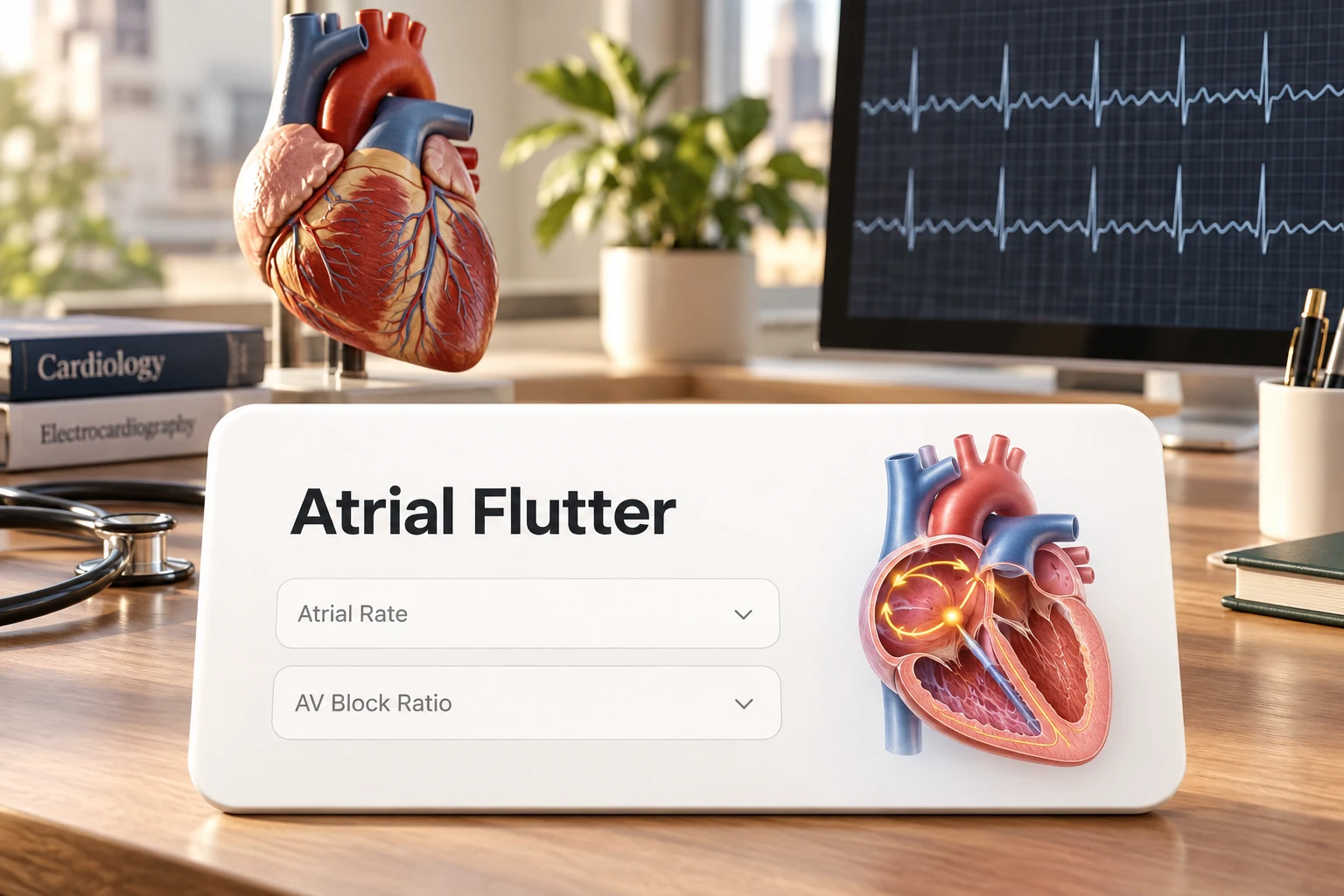
AV Nodal Block in Atrial Flutter calculator
Result
150bpm
Rate uncontrolled — beta-blocker or verapamil
2:1 AV block with atrial rate 300 bpm → ventricular rate 150 bpm.
How to use it
- 1
Identify atrial rate. Flutter waves (sawtooth) typically 250–350 bpm. Measure F-F interval.
- 2
Count AV ratio. Identify QRS relative to flutter waves. 2:1 = every other flutter wave conducts (most common, HR ~150 bpm from flutter rate 300).
- 3
Rate control. Target HR <80 bpm at rest. AV nodal agents: metoprolol, verapamil, diltiazem, digoxin.
When to use it
- ECG interpretation of regular SVT at 150 bpm
- Flutter with 2:1 block is the classic cause. Look for flutter waves in V1, II, III, aVF if not obvious.
- Rate control titration
- Increasing AVB ratio (2:1 → 4:1) with AV nodal agents.
- Pre-cardioversion
- Rhythm control (cardioversion or ablation) is preferred for flutter — rate control often inadequate long-term.
A reference for clinicians and students, not medical advice. A score supports a decision; it does not make one. Check every result against the patient in front of you and your local protocol.
At a glance
- Specialty
- Cardiology
- Inputs
- 2
- Type
- Formula
More in cardiology
- CHA₂DS₂-VAScCardiology · 8 inputs
- CHADS₂Cardiology · 5 inputs
- GRACE ScoreCardiology · 8 inputs
- HEART ScoreCardiology · 5 inputs
- TIMI Risk Score (NSTEMI/UA)Cardiology · 7 inputs
- TIMI Risk Score (STEMI)Cardiology · 8 inputs
- HAS-BLEDCardiology · 9 inputs
- Mean Arterial PressureCardiology · 2 inputs
- Pulse PressureCardiology · 2 inputs
- QTc CalculatorCardiology · 3 inputs
- Revised Cardiac Risk IndexCardiology · 6 inputs
- Framingham Risk ScoreCardiology · 8 inputs