Cardiology
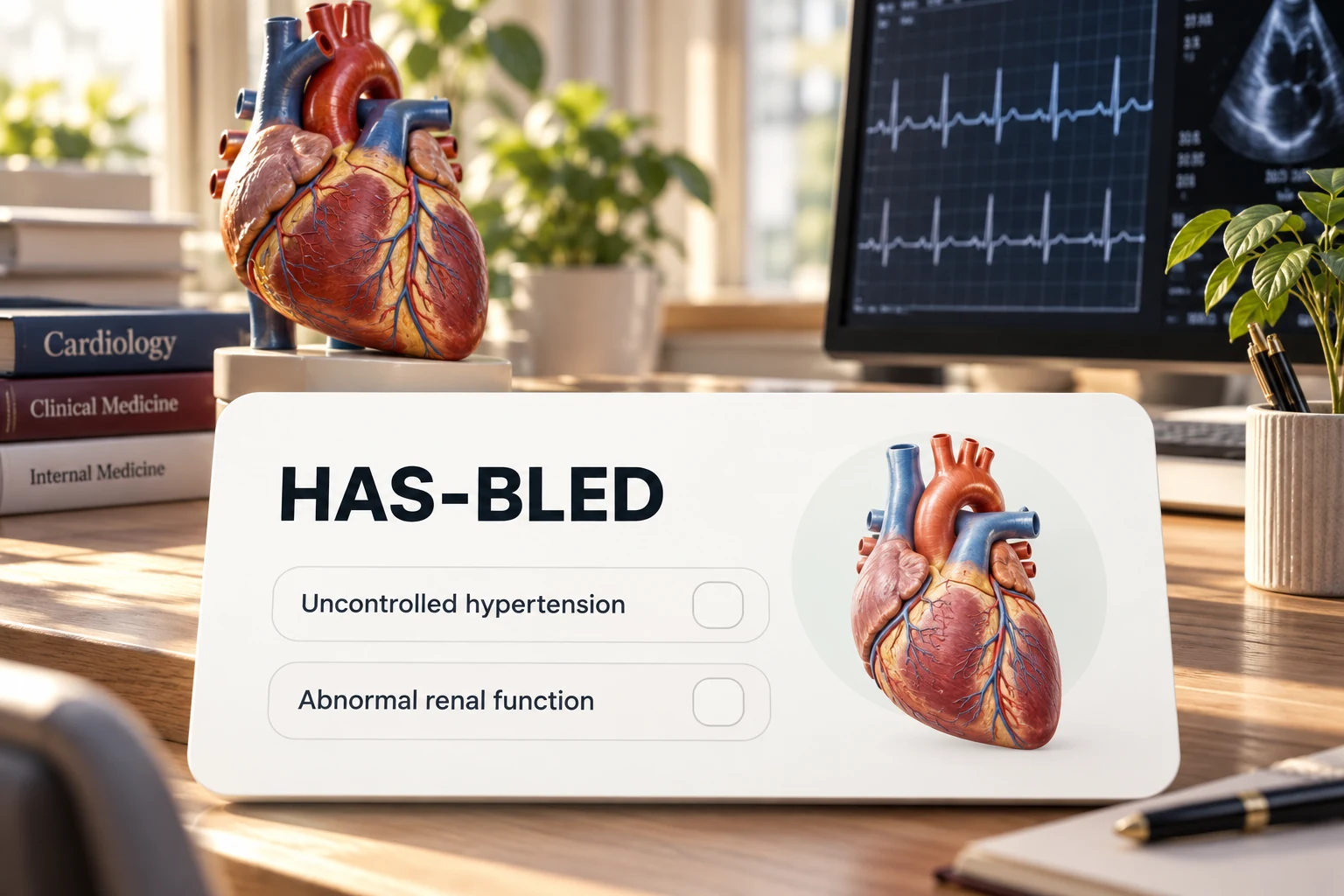
HAS-BLED Bleeding Risk Score
Estimate major bleeding risk in atrial fibrillation patients on anticoagulation.
HAS-BLED calculator
Result
0points
Low bleeding risk (~1–2%/yr)
How to use it
- 1
Score each H-A-S-B-L-E-D criterion. Hypertension, renal/liver dysfunction, stroke history, bleeding, labile INR, elderly, drugs/alcohol — each scores 1.
- 2
Identify modifiable factors. HTN, labile INR, NSAIDs/antiplatelet use, and alcohol can be addressed to lower bleeding risk.
- 3
Interpret in context. High HAS-BLED should not automatically deter anticoagulation — the stroke risk usually outweighs it. Use to flag correctable risks.
When to use it
Assess in all AF patients being considered for or already receiving anticoagulation. Use in parallel with CHA₂DS₂-VASc to balance stroke prevention against bleeding risk. Most useful for flagging modifiable bleeding risks that can be corrected before or during anticoagulation.
- Initiating anticoagulation in AF
- Paired with CHA₂DS₂-VASc. High bleeding risk (≥3) requires optimisation of modifiable factors, not necessarily withholding AC.
- Reviewing anticoagulation
- Annual reassessment. Score can change with age, new medications, or renal decline.
- Not a veto tool
- HAS-BLED ≥3 flags risk but rarely overrides clear anticoagulation benefit in high-stroke-risk AF.
About the score
HAS-BLED is the most widely validated bleeding risk score for patients with atrial fibrillation who are receiving or being considered for oral anticoagulation. It was developed to help clinicians identify and address modifiable bleeding risk factors rather than to withhold anticoagulation. A high HAS-BLED score should prompt correction of reversible risks (uncontrolled hypertension, labile INR, concurrent antiplatelet/NSAID use, alcohol excess) and more frequent clinical review — not automatic exclusion from anticoagulation. Used alongside a stroke risk score: CHA₂DS₂-VASc, or CHA₂DS₂-VA in the ESC 2024 AF Guidelines.
Hypertension, Abnormal renal/liver function, Stroke history, Bleeding history, Labile INR, Elderly (age >65), Drugs/alcohol
Scoring criteria
- Hypertension (uncontrolled, SBP >160 mmHg)
- 1
- Abnormal renal function (dialysis, transplant, creatinine >200 µmol/L)
- 1
- Abnormal liver function (cirrhosis, bilirubin >2×ULN, ALT/AST/ALP >3×ULN)
- 1
- Stroke history
- 1
- Bleeding history or predisposition (anaemia)
- 1
- Labile INR (time in therapeutic range <60%)
- 1
- Elderly (age >65 years)
- 1
- Drugs (antiplatelets, NSAIDs) or alcohol (≥8 units/week)Drugs = 1 point; alcohol = 1 point; both possible simultaneously
- 1 or 2
Score interpretation
- 0–1Low bleeding riskAnticoagulation appropriate; standard follow-up
- 2Moderate bleeding riskAddress modifiable factors; anticoagulation still appropriate
- ≥ 3High bleeding riskCorrect modifiable risks; frequent clinical review; do not withhold anticoagulation based on score alone
Guideline recommendation
ESC 2024 AF Guidelines: assessing and managing modifiable bleeding risk factors is recommended in all patients eligible for oral anticoagulation (Class I, Level B), and bleeding risk scores should not be used to decide on starting or stopping anticoagulation (Class III, Level B). The ESC 2020 guideline recommended HAS-BLED to address modifiable risk factors and to flag patients at high bleeding risk (score ≥3) for earlier and more frequent review (Class IIa, Level B). A high score is not a contraindication to anticoagulation — net clinical benefit of anticoagulation typically outweighs bleeding risk in patients at high stroke risk.
Clinical pearls
- A score ≥3 flags high bleeding risk but should NOT automatically lead to withholding anticoagulation — the stroke risk almost always outweighs bleeding risk.
- Focus on correcting the modifiable items: control blood pressure, review concurrent drugs (stop NSAIDs/antiplatelets if possible), address alcohol use, and optimise INR control.
- The labile INR item applies only to patients on a vitamin K antagonist (time in therapeutic range <60%); on a DOAC it scores 0.
- Reassess at every clinical review — modifiable factors can be resolved, lowering the score.
Limitations
- The maximum score is 9 (drugs and alcohol score 1 point each); calibration above 3 is less reliable.
- Does not distinguish between major and minor bleeding events.
- Less validated for NOACs than for warfarin in original derivation cohorts.
A reference for clinicians and students, not medical advice. A score supports a decision; it does not make one. Check every result against the patient in front of you and your local protocol.
At a glance
- Specialty
- Cardiology
- Inputs
- 9
- Type
- Points score
- Guidelines from
- ESC
Frequently asked questions
What HAS-BLED score is considered high risk?
A score of ≥3 is classified as high bleeding risk (ESC 2020). However, this should prompt correction of modifiable bleeding risk factors and more frequent monitoring — not automatic discontinuation or withholding of anticoagulation.
Can I use HAS-BLED to decide whether to start anticoagulation?
No. HAS-BLED is designed to identify modifiable bleeding risks, not to override the anticoagulation decision, and the ESC 2024 guideline advises against using bleeding risk scores to decide on starting or stopping anticoagulation. Pair it with CHA₂DS₂-VASc — for most patients with score ≥2 on CHA₂DS₂-VASc, the net clinical benefit of anticoagulation outweighs the bleeding risk even with a high HAS-BLED score.
What counts as labile INR for HAS-BLED?
Time in therapeutic range (TTR) less than 60% on warfarin qualifies. If the patient is on a NOAC, this criterion does not apply — NOACs eliminate INR variability, which is one advantage they hold over warfarin in patients with labile INR.
More in cardiology
- CHA₂DS₂-VAScCardiology · 8 inputs
- GRACE ScoreCardiology · 8 inputs
- CHADS₂Cardiology · 5 inputs
- HEART ScoreCardiology · 5 inputs
- TIMI Risk Score (NSTEMI/UA)Cardiology · 7 inputs
- TIMI Risk Score (STEMI)Cardiology · 8 inputs
- Mean Arterial PressureCardiology · 2 inputs
- Pulse PressureCardiology · 2 inputs
- QTc CalculatorCardiology · 3 inputs
- Revised Cardiac Risk IndexCardiology · 6 inputs
- Framingham Risk ScoreCardiology · 8 inputs
- Killip ClassificationCardiology · 1 input